Monday, November 15, 2010

Privacy vs. Anonymity

Falling costs and error rates (TheRegister.co.uk)
The state of the art can be illustrated by some of the examples given by the US National Institute for Standards and Technology (NIST) in their presentation on testing biometrics.

* A “1 in 1.6m” (that is, looking for one photo in a database of 1.6m photos) search on a 16-core 192Gb blade (about £25,000 worth of machine) takes less than one second (and the speed of such a search continues to improve). So if you have a database of a million people, and you’re checking a picture against that database, you can do it in less than second.

* The false non-match rate (in other words, what proportion of searches return the wrong picture) best performance is accelerating: in 2002 it was 20 per cent, by 2006 it was 3 per cent and by 2010 it had fallen to 0.3 per cent. This is an order of magnitude fall every four years and there’s no reason to suspect that it will not continue.

* The results seem to degrade by the log of population size (so that a 10 times bigger database delivers only twice the miss rate). Rather fascinatingly, no one seems to know why, but I imagine it must be some inherent property of the algorithms used.
The linked article is an opinion piece by David GW Birch, a smart man and (unashamed) Ramones fan. The piece is very interesting and I encourage people to read the whole thing.

A common refrain around here is: Identity management is about people, and Mr. Burch seems to get this, too. Towards the end of the piece, however, he seems to conflate privacy with anonymity.

Privacy in public is something we all take for granted. It is not difficult to assert an assumption of privacy covering observable public acts. If those acts are, however, assembled together by someone else and communicated to a third party, privacy can be greatly undermined.* The difference between having a private detective following you and not having one follow you makes for a useful illustration. Violation of public privacy has simply been a matter of resources and efficiency for the entirety of human history. Granted, modern technology stands to make undermining public privacy cheaper.

Anonymity in public is something different, and has probably only existed since the advent of rapid transit and the modern megalopolis -- and it's not necessarily a good thing.

We're all used to hearing about a "right to privacy" however overused the phrase may be. But it's unusual to hear someone posit a blanket, public right to anonymity, though in certain circumstances one undoubtedly exists: Political speech against oppressive regimes or religious confession, for example.

Mr. Burch subtly transitions to "online" anonymity when he begins the discussion of anonymity, but it's unclear how biometrics in general or facial recognition in particular stand to undermine online anonymity. Google's doing yeoman's work in this regard already.

Utilitarian thoughts:
It is possible that we value public privacy because it improves interpersonal relations among strangers.

Is it reasonable to view public anonymity with more skepticism because the opposite may be the case?

*UPDATE: The preceding two sentences were edited for clarity.

Friday, November 12, 2010

Cyprus: Biometric passports here at last

The long-awaited biometric passports will be available in Cyprus by the end of the month (Cyprus-Mail.com)
Cyprus has until now, been kept out of the US visa waiver programme because the island’s passports were not biometric. It now remains to be seen how long it will take for the US to give the green light for visa-free travel to the States by Cypriots.

Thursday, November 11, 2010

OmniPerception defends accuracy of biometric technology

More push-back on the NRC report (PRFire.co.uk)
The point is to design in the probabilistic nature of the technology. Make sure you know how to cope when people cant enrol. Make sure you understand the impact on your system if someone fails to be correctly recognised and then you never know, the solution might be as simple as even putting a microphone or camera next to the reader.

It's about people and ROI, not infallibility.

Wednesday, November 10, 2010

Eye movements as biometric identifiers?

For Your Eyes Only (TechnologyReview.com)
The way you view the world is unique, so why not use it to identify you?

A company in Israel has developed a security system that does just this--exploiting a person's unique pattern of eye movements to identify them. Most biometric security systems measure physical features that are constant, such as fingerprints or iris patterns. An eye-tracking system has the potential to be harder to fool and easier use, its creators say.
My first thought was to compare this to using a handwritten signature as a biometric. The biometric consists of the unique way in which someone moves a part of their body.

This would seem to be analogous to handwriting analysis because the way the system induces a subject's eye movements (by visually tracking a moving icon) isn't the same in each verification, the way your signature is meant to be (approximately) the same each time you sign something.

Report Forecasts the Global Biometric Market To Grow At A CAGR of Around 22% between 2011 and 2013

PRInside.com Press Release
Purchase from Research and Markets
At the regional level, North America dominates the global biometric market and is expected to account for a market share of over 30% in 2010. The Asian, Middle East and Africa region are also expected to emerge as growing markets for biometrics by 2013. In fact, the Gulf and African countries have already taken several initiatives and started various biometric programs.

Tuesday, November 9, 2010

California University Campus Reports 300% Return On Investment After First Year Of Using Biometric Technology

300% Return On Investment After First Year (PR-Inside.com)
LAS VEGAS --(November 8, 2010) – Cal Poly Pomona Foundation, Inc. reported today that it has realized a 300% return on investment in biometric technology during the first year of deployment. It has implemented M2SYS Technology’s biometric fingerprint technology with its Kronos time and attendance software, enabling employees to use fingerprint readers to clock in and clock out at the beginning and end of shifts and lunch breaks.
A common theme around here has been making the case that biometric implementations are too frequently expected to provide perfect identification regimes, rather than improving upon real-world results while saving money. What makes adoption of biometric identity management techniques worthwhile isn't perfection, it is return on investment ROI.

Congratulations to all involved.

Other posts touching upon ROI

Monday, November 8, 2010

Queensland biometric driver licence rollout begins

The rollout follows successful trials by the Queensland Government (ComputerWorld.com.au)
A biometric driver licence system has been unveiled in Toowoomba as the Queensland Government begins replacing old licences to combat identity fraud.
...
Transport Minister, Rachel Nolan, said the move was significant, describing the new system as "the most secure driver licence system in the country".

New Zealand police won right to capture biometric information outside the police station environment

Police ponder portable computers (Stuff.co.nz)
Police won the right to capture biometric information, such as fingerprints, of people they intended to charge outside the police station environment in the Policing Act – passed by the former Labour government in 2008.

The devices, which spokeswoman Claire Harman said were "very much at the concept stage", would replace computers installed in a small number of police cars that will become redundant in 2012 when Telecom switches off its CDMA mobile network.

Ms Harman said police were looking at handheld, in-car portable and fixed in-car options. "Neither fingerprinting, nor photographing would be deployed as part of the initial rollout."
These days, hand-held computer technology often far outstrips the capabilities of police Mobile Data Terminals (MDT's, in-car computers), at a fraction of the cost.

As a practical and evidentiary matter, it would seem capturing biometric information such as mugshots and fingerprints in a controlled environment will be preferred by law enforcement agencies in the vast majority of instances.

Friday, November 5, 2010

Govt tells officials to stay off porn sites

HindustanTimes.com
A government official, however, indicated that it wasn’t “the most realistic set of guidelines”.
OK. That was a little bit out of context but I couldn't resist.

Germany's e-ID Cards Spark Privacy Debate

MaximumPC.com
The problem many Germans have is that the e-ID cards simply store too much personal information, including date of birth, place of birth, address, biometric photo, and voluntary fingerprints. It's basically a digital goldmine for data thieves. Or Big Brother.

Thursday, November 4, 2010

News Round-up: Border Controls

Today's Biometrics news is all about border control:

State Dept's Amin presses for expanded use of biometrics
(Federal News Radio) Streaming Audio and MP3 download at the link
In order to better protect the nation's security, one of the State Department's top IT officials says Americans need better biometrics in the visa and passport process.
EU seeks to strengthen rules on border patrols (EuropeanVoice.com)
The European Union is considering setting up a reserve of border guards to respond to surges in illegal migration such as that experienced in recent months in Greece.
Skipping the Line at Customs (Wall Street Journal)
International frequent fliers are hailing a program called Global Entry, a "trusted traveler" program run by U.S. Customs and Border Protection.

Wednesday, November 3, 2010

L-1 Identity Solutions Reports Third Quarter 2010 Financial Results

L-1 Expects Sale of L-1 Intelligence Services in Q4 2010 and Acquisition of L-1 by Safran SA in Q1 2011 (BusinessWire.com)
L-1 expects revenue for the full-year ending December 31, 2010 of $685.0 million - $690.0 million, revised from $715.0 million - $725.0 million due to the delay in commencing recently booked biometric and credentialing international programs, coupled with multiple Federal credentialing opportunities sliding into 2011 and a postponement of HIIDE and PIER sales to government customers (see footnote 1).

Tuesday, November 2, 2010

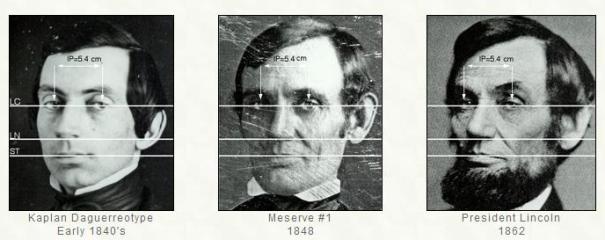
Honest! Abe Lincoln's earliest photo finally 'confirmed'

Facial-recognition software examines daguerreotype bought for $27 (World Net Daily)
Facial recognition expert Robert Schmitt has produced a video in which he analyzes a daguerreotype that may be the earliest photographic image taken of Abraham Lincoln against well-known images of the 16th president.

The daguerreotype, identified only as a "Portrait of a Young Man," was obtained in 1977 by collector Albert Kaplan, who purchased the image for $27 from among a group of 100 being sold by an art gallery on 57th Street in New York City.
The exercise described in the article is very different than the type of identification we usually discuss here, but it is fascinating nonetheless. Video and many more photos at the link.

Delaware Newspaper Endorses...

...Fingerprint Biometrics in Schools! Well, sort of...
Schools should consider usefulness of fingerprinting (Delaware Wave)
In an era of computer hacking -- the ultimate in human technological malfeasance -- that's no privacy assurance.

Human ingenuity will eventually take care of that problem.

For now, Delaware schools should consider the usefulness of this technology.
On this election day, the most interesting endorsement I found in the morning news wasn't for a political candidate. Rather, it was for keeping an open mind on biometrics in schools.

Monday, November 1, 2010

Biometrics & Elections

It's election season in many places around the world. Two elections, in particular, have gotten attention for their adoption of biometric identity management techniques.

Brazil elects Dilma
(CNN.com)
In 60 Brazilian cities, voters used their thumbs instead of ballots on a newly launched biometric system, where voters scan their fingers to log in and vote.
Brazil and Cote d'Ivoire have very different reasons for their decisions. In Brazil, voting is compulsory, so practically every adult cast a vote. Anything that increases the efficiency of the voting process is likely to pay dividends at such high turnout rates. An earlier post about the Brazilian elections is here.

Ivory Coast election a crucial crossroads (Forbes.com)
Cote d'Ivoire has a very different set of challenges.
"Ivorians want to have peaceful elections. People are tired," said journalist and political analyst Abdoulaye Sangare. But if any party fails to accept the outcome, "there could be violence. And if there is, nobody can say where it might stop."

From Travel.State.gov:
Cote d'Ivoire has been a divided country since a 2002 failed coup attempt evolved into an armed rebellion that split the country in two. Ivorian President Laurent Gbagbo and New Forces leader Guillaume Soro signed the Ouagadougou Political Agreement (OPA) in March 2007, and a new government was formed with Soro as Prime Minister (PM). Implementation of the accord, including federal elections, is ongoing, but long-awaited elections have been postponed repeatedly.
In such a fragile country, the integrity of the vote is of paramount importance. It's not too much of a stretch to assert that thousands of lives are at stake, depending upon a clean election to maintain peace.

Friday, October 29, 2010

Finger-ID technology comes to Erie High

Finger-ID technology comes to Erie High; critics worry about data security (Daily Camera [Colorado])

Fingerprint biometrics streamline the school lunch process and the kids love it.

The quote from the ACLU spokesman really got my attention.
Judd Golden, chairman of the Boulder County chapter of the American Civil Liberties Union, said the whole question of safeguards in the technology is critical.

"Parents ask, 'Who's got my child's data?'" he said. "Do they have safeguards against possible misuse of that data? It's collecting discreet, personal identifying information, and that data is not necessarily under the control of the district but a third-party vendor."
Rather than knee-jerk reactions, these are exactly the kinds of questions concerned citizens should be asking. Kudos to Mr. Golden.

One more observation:
Despite the obligatory addition of "critics worry about data security" to the headline, no critics are actually quoted in the article. Perhaps the author was referring to the several parents who were upset that the school acted without a proper give-and-take with the public. If that's the kind of critics that adopters of biometric identity management techniques are up against, then that's a situation that can be managed around a civil, rational dialogue.

Thursday, October 28, 2010

Sheriff's department to demo new eye scanners

Boone County Sheriff’s Department is showing off the new iris scanners that are available to deputies and the Boone County Jail (ColumbiaTribune.com)

Iris biometrics are being rapidly adopted by jails.

To understand why, it is useful to have a working knowledge of the framework outlined in:

NATIONAL BIOMETRIC TEST CENTER COLLECTED WORKS 1997-2000 (1.8MB PDF), specifically Chapter 1, section II 'Classifying Applications' (page 13 in your PDF reader, page 3 according to the document's internal numbering).

The categories are:
Cooperative v. Non-cooperative
Overt v. Covert
Habituated v. Non-habituated
Attended v. Non-attended
Standard Environment
Public v. Private
Open v. Closed

Some of these distinctions refer to the individual to be identified while some refer to the technology.

Nowhere have I found a more understandable and concise elucidation of how to understand biometrics in particular and security in general.

Nigerian Ghost Busters

Who you gonna call? Biometrics! (AllAfrica.com)
Lagos — Imo State government has uncovered 184 ghost primary school teachers in the state following a recent biometric staff audit.

This was disclosed to the Governor Ikedi Ohakim by Mr. Dan Okehi of Brickred Consult, at the Executive Council Chambers, Government House, Owerri where he submitted the audit report

Mr. Okehi said that out of the 15,860 teachers that filled the biometric form, only 14,363 were found to be authentic staff of the state Universal Basic Education Board, while 194 were non existence, yet taking salaries.

A ghost worker is a worker that collects a salary and/or benefits, usually from a government entity, while doing no actual work. A ghost worker may or may not be a real person, but the money they make is real and it accrues to a corrupt official.

The old Gummi Bear trick

Sweet bypass for student finger scanner (ZDNet.com)
But a litany of fingerprint scanners have fallen victim to bypass methods, many of which are explained publicly in detail on the internet. The hacks could potentially be used by students to make replicas of their own fingerprints, or lift those of others from imprints left on the reader.
Imperfect is not the same thing as impractical.

Schools spend a lot of resources in their Identity Management function: calling roll, assigning grades, managing a medical services office (school nurse), collecting health information on student athletes (physical exams), etc. Moreover, in the United States, this challenge occurs in a very strict legal environment (see FERPA).

We all have an interest in how efficiently an industry that is overwhelmingly funded by tax revenues manages its resources. Schools should therefore be encouraged to adopt more effective means to accomplish the demands society places upon them and they should be commended for innovation within their industry.

This article is about using fingerprint readers to measure time-and-attendance in schools. This function is usually carried out by human teachers, reading names from a piece of paper and making notes on a piece of paper. Because human beings are simply the best things in the world at identity management among people they know, this system works really well. But at what cost?

Is reading the names of people from a list really the best use of a highly trained, educated, and professional human resource? Are the constraints this system places upon class size worth it? What metrics would a rival system need to show in order to make switching systems worth the effort and cost? Sadly, questions like these are rarely, if ever, asked in articles like these.

There's also a social angle to this issue. The educational system is wonderful and necessary, not just for filling young minds with humanity's accumulated knowledge, but also for providing a social environment larger and more complex than the nuclear family but far more protected than the larger world. Much of the usefulness of this social environment lies in its ability to communicate to students the boundaries of acceptable behavior in preparation for their full participation in society as adults.

Of course, during this social education, society's rules are sometimes more honor'd in the breach than the observance (see "Ferris Bueller's Day Off", "Animal House", etc.) and that's fine, too, but it's also why this part of the educational process is so important. "Senior Skip Day" or senior class practical jokes are OK. Cheating on exams, not so much.

Which brings us back to the linked article with the sub-headline:
A NSW high school has installed "secure" fingerprint scanners for roll call, which savvy kids may be able to circumvent with sweets from their lunch box.

The scare quotes around "secure" invite the familiar (around here) refrain: "Compared to what?" Deeming young identity thieves "savvy kids" implies that the author believes that a technology's inability to overcome failures of educational will is a technological, rather than an organizational shortcoming. In the real world, identity theft and fraud can get you thrown in jail. Educators don't call those who cheat on exams, skip school and forge notes from parents "savvy kids". Why would they do so when the issue is identity theft? They wouldn't.

In answer to the "Compared to what?" question, I'd place fingerprint biometrics between full-time teachers and substitute teachers in terms of identity management effectiveness at a fraction of the cost.

Adopting technology to alleviate a bureaucratic problem often makes sense, but this issue is totally separate from a student's social education. If educators are unwilling to monitor for- and punish the hacking of time-and-attendance systems through identity theft among their students, the "technology" won't work. If they treat use of the system in the same way they treat other student responsibilities, it will.

Thankfully, educators have a very different sense of their responsibilities than does this article's author.

Monday, October 25, 2010

3M Extends Subsequent Offering Period for Shares of Cogent, Inc.

The expiration date of the subsequent offering period has been extended to 5:00 PM, October 26, 2010 (Finance.Yahoo.com)
If, following expiration of the subsequent offering period, Ventura Acquisition Corporation owns more than approximately 66.5 million Cogent shares, 3M intends to exercise the option, under the terms of the previously announced merger agreement, to purchase directly from Cogent a number of additional shares sufficient to give Ventura Acquisition Corporation ownership of one share more than 90% of Cogent’s outstanding common stock. This would permit Ventura Acquisition Corporation to complete a short-form merger with Cogent under Delaware law without the need for a meeting of Cogent’s shareholders.
Ventura Acquisition Corporation is wholly owned by 3M.

Queensland, Australia to adopt biometric driver's license

QLD biometric licenses to go ahead (ComputerWorld.com.au)
The new licence features an embedded chip with personal information, security PIN and shared secrets, and also utilises 16 point facial recognition technology. When drivers renew or apply for the new licence, a digital photograph will be taken and centrally stored. Each subsequent renewal of the licence will reference the image and using the facial recognition technology to ensure the driver is who they claim to be.
For information on what was driving the changes see this article from the same source.

Friday, October 22, 2010

Biometrics to be required of certain UK visa renewal applicants?

Biometric permits on the cards for Tier 1 and Tier 5 UK Visa applicants (VisaBureau.com)

If Parliament adopts the proposed new rules...
If you make your application to extend your stay in the UK by post, the Border Agency will send you a letter after receiving your application. The letter will tell you how to book an appointment to enrol your biometric information at one of the biometric enrolment centres.

Thursday, October 21, 2010

UPDATE: Pilot's Licenses don't have photos?

UPDATE: TSA, Pilots Weigh Biometric System for Airport Screening (NationalJournal.com)
Pilots who fly passenger and cargo planes want the U.S. government to implement a program under which their identities will be confirmed using biometrics so they can pass quickly through airport security checkpoints and avoid -- for the most part -- controversial screening procedures involving body scanners or pat-downs.
The recent controversy over airport screenings has had at least one positive effect. All of a sudden, pilots are embracing biometrics as an identity management technique that is far less intrusive into privacy and conducive to security than many alternatives.

--Original post follows--
Today, the only pilots pictured on FAA licenses are flight pioneers Wilbur and Orville Wright (MSNBC.com)
In an attempt to improve security, Congress told the Federal Aviation Administration in 2004 to come up with a pilot's license that included the pilot's photo and could contain biometric information like fingerprints or iris scans. Today, the only pilots pictured on FAA licenses are flight pioneers Wilbur and Orville Wright, and the licenses lack biometric data.

This is astounding, especially when read together with this, via Drudge: Pilot Refuses Full-Body Scan, Says TSA Doesn’t Make Travel Safer (NewYork.CBSLocal.com)

Then there's this from two days after 9/11: Police investigating theft of American Airlines uniforms, key card (CNN.com)

There's always a risk that changes in security measures will be resisted or skirted by those falling under the new rules. That's why it's always a good idea to consult with the people the new measures will affect when implementing or changing a security plan. These are the people that can make or break your efforts to achieve your security goals.

A common refrain around here is that security, biometrics and ID management are all about people.

The civilian air travel bureaucracy really has people problems everywhere they turn. Their customers/stakeholders don't like them and their employees don't like them, either. Skipping obvious, low tech solutions like photo ID's for pilots while instituting intrusive, annoying, expensive and time consuming solutions falling on everyone seems calculated to communicate the appearance of security over substantially increasing the safety and, hence, value proposition that government agencies offer their stakeholders and airlines offer their customers.

US Gov, Northrop Grumman test emergency ID interoperability system

The demonstration, dubbed "Autumn Blend," showed the use of standardized personal identity credentials operating across multiple domains (MSNBC.com, giant font alert)
One of the scenarios of the Autumn Blend demonstration simulated a collaborative incident at Northrop Grumman's Shipbuilding facility in Newport News, Va. As first responders from the city, Commonwealth and federal government convened on the site, their individual personal identity credentials were presented and read electronically at various authentication points for physical and logical access to the demonstration. These credentials included the U.S. Department of Defense Common Access Card, First Responder Authentication Credential, Personal Identity Verification and Personal Identity Verification-Interoperable credentials.

This is really cool. There are hundreds of forms of ID out there. Take one rush hour ride on the DC Metro and you'd be amazed at how many different ID's you'll see dangling from the riders' clothes and accessories.

Developing a system that can translate among various forms of ID in an emergency has obvious benefits.

Wednesday, October 20, 2010

Fingerprint biometrics among safest identity protection tools

How do you protect your identity? It takes more than just passwords (FederalNewsRadio.com)
Streaming Audio & MP3 download at the link

Following on the Unisys survey we mentioned here comes this:
Bryan Ichikawa, vice president of identity solutions at Unisys, joined the DorobekINSIDER to discuss the most secure way to protect your identity.

Tuesday, October 19, 2010

Desert Sands, CA may test biometric school bus rider tracking

Students participating in the test would swipe a finger across a scanner on the bus every time they board and exit.

An alarm would trigger if a student tried to get on or off at the wrong stop.

“It's definitely a wonderful safety component,” Superintendent Sharon McGehee said.

In 2007, three first-graders from Desert Sands were mistakenly dropped off at the wrong location early in the school year and rescued by neighbors.
I think a lot of people would be surprised to learn just how challenging a school's identity management environment really is.

First, school is compulsory; most parents really don't have much of a choice about whether or not to send their child to school. The compulsory nature of school attendance places an extraordinary burden on schools to ensure student safety. The added fact that children are legally recognized to be unable to take responsibility for themselves necessarily increases the responsibility schools have regarding child safety.

Given these responsibilities, can anyone be surprised that schools are among the vanguard of biometric solution adoption? It would be strange if they weren't.

Monday, October 18, 2010

Citibank to roll out voice biometrics


Funny CEO image of the day...
"I personally registered and then tried to beat it. I spoke in a girl's voice. I muffled my voice ... I pretended I had a cold. It got it right," he said.

Friday, October 15, 2010

Army Takes Hands-On Approach to Biometrics Sharing

Formerly known as the Biometrics Task Force, the Biometrics Identity Management Agency in March became a full-fledged U.S. Army agency with a departmentwide mission. Swan foresees a time when biometrics data will be used to identify friendly or enemy troops wounded on the battlefield, to ensure soldiers and their families receive authorized health care, and to identify displaced persons or track those who have received emergency rations following natural disasters:

Thursday, October 14, 2010

Unisys Poll: 63% of credit card users would prefer fingerprint

[Almost] Two-Thirds of Consumers Prefer Credit Card Verification by Fingerprint (EarthTimes.org; UPDATE: broken link removed)
Responding to the question, "Which do you believe is the safest method to prove your credit card is being used by you?" the online poll found that 63 percent of more than 300 respondents preferred fingerprints as the best method for identity verification and authentication as compared to photo identification (20 percent), PIN numbers (13 percent) and handwritten signatures (six percent).

This poll gets at the "compared to what?" question we frequently ask here. It explicitly asks respondents to compare a biometric modality to what techniques/technologies are currently in use and, unsurprisingly, consumers find the status quo wanting.

I also think it's worth noting that the second-preferred choice, Photo ID (20%), is also a biometric. The photo on the ID is the database image and the customer's face is the probe image. The biometric matching algorithm is within the brain of the person making the comparison.

So, 83% of those surveyed believe biometrics serve their information security better than PIN's and signatures.

Wednesday, October 13, 2010

Biometrics: Humans as Keys

The Future of Biometrics by research consultancy Acuity Market Intelligence (ElectronicsNews.com.au)

Here's a good summary of a recent industry report on some challenges and opportunities in the ID management sphere.
Any remaining problems with biometrics will no doubt be ironed out with time, as new technological developments emerge, and standards are developed for the technology However, the industry is more interested in the bigger picture, integrating biometrics into existing and new applications, not so much as a standalone one-size-fits-all security technology, but as enhanced solutions to existing and new challenges.

Tuesday, October 12, 2010

Ears provide new way of identifying people

"With biometrics, a lot of the problems is what happens when people get old. With facial recognition, the systems are often confused by crows feet and other signs of ageing. Your ears, however, age very gracefully. They grow proportionally larger and your lobe gets a bit more elongated, but otherwise your ears are fully formed from birth."

Ears have been in the biometrics news a lot the last few days.

Pros:
-Facial recognition accuracy is degraded as the pose angle diverges from a full frontal view. As pose angles get bigger, an ear will come into view. Tying an ear-recognition system to a face recognition system could make more identifications possible, especially with a non-participating subject.

Cons:
-Ears aren't really that stable. They grow throughout life, as the quote above addresses.
-As high school wrestlers can attest, ears are easily deformed by trauma.
-Hair obscures significant portions of the ear in a significant percentage of the population.

That's not to say that they aren't or won't be useful.

As a wise man once said: "Biometric X is a great biometric, if it's the only one you have."

There are bound to be applications where the ear is the only anatomical identifier at hand and for those applications ear-recognition algorithms will be useful.

Friday, October 8, 2010

Thursday, October 7, 2010

Giving identity to Delhi’s homeless

HindustanTimes.com
For Abida Begum (20), a homeless woman who makes Rs 100 a day washing clothes in the untidy sprawl of Delhi's Nizamuddin Basti, India's Unique Identity (UID) project will, hopefully, stop constant police probing and harassment.
...
“I am told that I can open a bank account with the card (number) given. We were unable to open one, all this time, because I could not give proof of address or who I am,” said Ibrahim, who's been living in the Capital for more than 10 years.
Can you imagine an existence where you couldn't identify yourself to anyone who didn't know you already?

This post mirrors these two dealing with Afghanistan.
Biometrics: Giving Afghans an identity
Biometrics: Giving Afghans an identity UPDATE

Wednesday, October 6, 2010

Busted: Woman, 81, jailed in vote-fraud case

Woman, 81, jailed in vote-fraud case (MySanAntonio.com, via Drudge)
Bexar County deputies Monday night arrested a woman accused of using her long-dead sister's identity to vote twice in the 2008 general election.
...
The Texas Department of Public Safety's image verification system matched the photo on Comparin's driver license to the one on the “Collins” license, according to the affidavit.

Brazilian election biometrics have 93.5% success rate

(News.Xinhuanet.com)
The website of the Diario Catarinense, from Port Alegre, the state capital of Rio Grande Do Sul, said that 742 biometric machines had been installed in the city, and only three removed from service due to problems, or around 0.4 percent. An official at the TSE said the machines should be rolled out to the whole nation in 2014.

Among English language media outlets, this topic seems to have generated interest in the Chinese press and not elsewhere.

I tried without success to chase down the Porto Alegre article for any Portuguese speakers out there. If any readers happen across it, I'll certainly post a link.

UPDATE:
This may be the article referenced by Xinhua:
Eleitores do município de Canoas (RS) aprovam urna biométrica

Nely Menetrier, 84 anos, também se mostrou satisfeita com a urna biométrica.

– Gostei da nova urna, foi fácil e rápido.
Translation:
84 year-old Nely Menetrier also expressed satisfaction with the biometric ballot box. "I liked the new ballot box; it was easy and fast."

Voting is compulsory in Brazil so technologies that make the process more manageable will have a large impact. It wouldn't shock me if more votes are cast in Brazil than any other country.

Did their voices betray them?

Did their voices betray them? The discovery of an alleged terror plot against Europe owes at least some of its success to "voiceprint" technology that allows law enforcement to electronically match a voice to its owner.

The technique – which some compare to fingerprinting – can be a powerful anti-terror tool, officials increasingly believe. Law enforcement agencies are already considering how a voice database could help thwart future plots.

Cogent-3M merger overcomes shareholder action

Pasadena-based Cogent, the developer of fingerprint and other biometrics devices, reported this morning that a Delaware court has denied a shareholder motion to block the acquisition of the firm by 3M.

Friday, October 1, 2010

Contract awarded for $142M FBI project

Once completed, the new facility will allow the FBI CJIS Division, which already has the largest centralized collection of biometric information in the world, and the Department of the Army, which has also developed military biometrics database systems in coordination with the FBI, to make advances into other identification technologies, such as DNA, iris, palm prints and facial recognition.

Wednesday, September 29, 2010

It's on: India Launches Project to ID 1.2 Billion People

The project, which seeks to collect fingerprint and iris scans from all residents and store them in a massive central database of unique IDs, is considered by many specialists the most technologically and logistically complex national identification effort ever attempted.

As the gathering of villagers cheered and applauded, Ranjana Sonawane became the first in the country to receive the Unique Identification Number (UID) card at a ceremony.

Pushback on the National Research Council (NRC) Report

"The report is out of date and misleading at best," says Michael DePasquale, CEO of BIO-key International. "The fact that it relies on data gathered over five years ago does a disservice to the industry, and to those individuals who have been pushing technological advancements since 2004. Over the last six years, the technology has made significant contributions to not only our national security, but also to protecting access to a wide variety of commercial applications including smartphones, laptops, offices, homes, commercial networks, point-of-sale terminals and medical storage cabinets."
The full report is available here (Registration Required).

There are many fault lines running through the biometrics sphere and nowhere are they better explained than in the classic NATIONAL BIOMETRIC TEST CENTER COLLECTED WORKS 1997-2000 (1.8MB PDF). I refer specifically to Chapter 1, section II 'Classifying Applications' (page 13 in your PDF reader, page 3 according to the document's internal numbering). Without a decent understanding of the categories into which biometric applications fall, confusion is inevitable.

The categories are:
Cooperative v. Non-cooperative
Overt v. Covert
Habituated v. Non-habituated
Attended v. Non-attended
Standard Environment
Public v. Private
Open v. Closed

Some of these distinctions refer to the individual to be identified while some refer to the technology.

Every one of the above factors will impact the technical suitability of a solution or the user's acceptance of a system to some degree or another and the Attended/Non-Attended (technical suitability) and Public/Private (social acceptability) categorizations are supremely important.

The report seems to have caused confusion in its readers along these two lines: attended vs. unattended systems, and public vs. private use. This quote from the report is emblematic:
Biometrics recognition has been applied to identification of criminals, patient tracking and medical informatics, and the personalization of social services, among other things. In spite of substantial effort, however, there remain unresolved questions about the effectiveness and management of systems for biometric recognition and societal impact of their use.

This post touches on the confusion resulting from a lack of attention to the attended/unattended distinction.
The system described in Mainz, above is an unattended system used on non-cooperative, non-habituated individuals in a public, non-standard environment. 60% is nothing to sneeze at and the proper frame of reference is 0% (the number of people identified in the absence of a system) not 100%. So, Mainz went from 0% identifications to 60% in the daytime (possibly) without any spending on human resources and this is failure?

This post, in part, examines whether your identity management solution is ever truly unattended:
Biometric identity management systems are not replacements for current security systems and protocols. They are augmentations of those systems. Very few security solutions are completely unstaffed.

The lock on your front door is apparently unstaffed, but is it? If you live in an apartment or are staying in a hotel and you lock yourself out, the front desk staff will verify your identity and issue you a new key. If you live in a house, a locksmith can verify your identity and gain access to your abode for you.

This post deals with the public/private distinction.
Bryan Glick at ComputerWeekly.com understands that the rejection of a statist, top-down approach does not mean that identity management systems are unnecessary or that all proposed systems will be rejected by a free public.

Glick then draws attention to a 2008 report by Sir James Crosby, then at HM Treasury, entitled Challenges and Opportunities in Identity Assurance (.pdf). The 47-page report contains a breadth of information that makes it a great introduction for how to begin thinking about the challenges associated with large-scale biometric identity management deployments. It is very accessible and deserves to be read widely.
At an early stage, we recognised that consumers constitute the common ground between the public and private sectors. And our focus switched from “ID management” to “ID assurance”. The expression “ID management” suggests data sharing and database consolidation, concepts which principally serve the interests of the owner of the database, for example the Government or the banks. Whereas we think of “ID assurance” as a consumer-led concept, a process that meets an important consumer need without necessarily providing any spin-off benefits to the owner of any database. This distinction is fundamental. An ID system built primarily to deliver high levels of assurance for consumers and to command their trust has little in common with one inspired mainly by the ambitions of its owner. In the case of the former, consumers will extend use both across the population and in terms of applications such as travel and banking. While almost inevitably the opposite is true for systems principally designed to save costs and to transfer or share data.
They say a horse by committee gets you a camel. I'll withhold final judgment on the NRC report until I've gone through it in more detail.

Tuesday, September 28, 2010

Australian Government launches security research network

ZDNet.com.au
Nominated researchers must be members of the Research Network Secure Australia and clear its professional background checks.

Deputy national security advisor Margot McCarthy said the network will tighten coordination on matters of national security in the public and private sectors.
This is a good idea.

Creating a directory of the pre-vetted security experts available to a country should foster the development of good working relationships within the security sector which should in turn make for better responses in a security crisis.

The directory is online here and contains rich contact information such as phone numbers and (sometimes multiple) email addresses.

If you're in Australia and have acute need of an expert in biometrics and securing biometric templates, give Boztas Serder a call or shoot Calic Dragana an email.

Security is about people and national security is no exception.

Monday, September 27, 2010

Monday Roundup

Three topics seem to be dominating biometrics news today:

Biometrics 'Inherently Fallible' (RedOrbit.com)
For perspective, see Saturday's post.
More articles: Bing News

WVU seeks volunteers for biometrics study (WVPubcast.org; Text & Audio)
Blog post here.
More articles: Bing News

Boston & Secure Communities (Boston.com)
More articles: Bing News

Saturday, September 25, 2010

National Research Council: Biometrics 'Inherently Fallible'

Regular visitors will be familiar with the themes in this article.

No security system is infallible. Biometric identity management solutions are getting so much attention precisely because existing identity management solutions are extremely fallible.

What determines the desirability of a biometric identity management solution is not infallibility but return on investment (ROI) -- a measure of the efficiencies such a system can bring to an organization's identity management function offset by the costs associated with adoption of the new solution. In many cases the ROI is reflected in productivity gains among staff responsible for an organization's identity management function.

It is very important, however, that potential adopters of biometric ID management solutions be aware of the issues the article raises.
The report notes that careful consideration is needed when using biometric recognition as a component of an overall security system. The merits and risks of biometric recognition relative to other identification and authentication technologies should be considered. Any biometric system selected for security purposes should undergo thorough threat assessments to determine its vulnerabilities to deliberate attacks. Trustworthiness of the biometric recognition process cannot rely on secrecy of data, since an individual's biometric traits can be publicly known or accessed. In addition, secondary screening procedures that are used in the event of a system failure should be just as well-designed as primary systems, the report says.
Identity management is about people, after all. These systems can really help organizations, but they're not magic.

Friday, September 24, 2010

Biometrics: Giving Afghans an identity UPDATE

 Following on this post last month comes this from Wired.com...

Army Reveals Afghan Biometric ID Plan; Millions Scanned, Carded by May
Scanning prisoners’ irises is just Step 1. In Afghanistan, local and NATO forces are amassing biometric dossiers on hundreds of thousands of cops, crooks, soldiers, insurgents and ordinary citizens. And now, with NATO’s backing, the Kabul government is putting together a plan to issue biometrically backed identification cards to 1.65 million Afghans by next May.

Interesting nugget:
There are all kinds of hurdles to the plan, however. At the moment, Afghanistan’s two main biometric databases don’t talk to one another, limiting their effectiveness.
SecurLinx customers don't encounter these problems and we can fix them for customers in need of increased interoperability. Our middleware increases the ROI on existing identity management systems.

Face Rec: Getting So Much Better All the Time

Granted, integrated face recognition/video surveillance systems are not perfect—false positives do happen. Still, “Accuracy has improved nearly two full orders of magnitude since the large scale studies [that were] published in 2002,” says Ken Nosker, president of Fulcrum Biometrics. “In the latest independent study published by NIST, researchers have shown that seven tested algorithms performed as good as or better at matching faces than humans were able to do.

Thursday, September 23, 2010

Behavioral Biometrics or Public Lie Detectors?

CIO.com
The linked article is confusing and heartening at the same time.

It is easily divided into two parts: a discussion of the efforts of some in the research community to bring lie detectors out of interrogation rooms and into contact with the public, and a brief summary of findings that public views on biometric identity management techniques differ from the way so-called privacy advocates frame the issues.

The reason that it is confusing is that the two parts of the article don't belong together.

The discussion of the Future Attribute Screening Technology (FAST) prototype has virtually nothing to do with public acceptance of biometric identity management techniques.

The techniques described under the label Behavioral Biometrics are akin to lie detector tests. They rely upon the detection of changes in bodily function resulting from some outside stimulus such as interrogation and seek to determine intent. Moreover, FAST attempts to automate this analysis as much as possible. This is like going from "Lie To Me" to "Minority Report".

["Lie to Me" is a current* TV show chronicling the adventures of one Dr. Lightman (Tim Roth), the world's greatest human lie detector. "Minority Report" takes place in a dystopian future where criminals are caught before crimes are committed.]

There's ample evidence that the "Lie To Me" scenario is at least reasonable. It is possible to train professional interviewers that can ferret out lies and attempts to deceive with some high degree of accuracy. In fact, these professionals are actively doing the job FAST attempts to automate every day in our airports and police stations.

While I am unqualified to make assertions of fact regarding the feasibility of developing a machine that functions with high reliability along the lines envisioned by FAST's creators, it is my guess that FAST, or a similar system, is not only possible in theory but highly likely to exist in reality in the not-too-distant future so long as current growth rates in human scientific knowledge and computational power continue.

But even if we accept that a FAST-like system will be technically possible in the future, say fifteen years from now, no current researcher could possibly say anything useful about whether or not the culture fifteen years from now would find it acceptable to use such tools in public places upon ordinary people without probable cause. Predictions about social views on technology fifteen years in the future more appropriately belong to the genre of science fiction than opinion polling.

None of this is to discredit University of Pittsburgh Dr. Lisa Nelson's
study of biometrics and the public views about it [that] reveals tolerance and support when it comes to government use of biometrics to protect public safety.

Although privacy advocacy groups are supposed to represent the public, Nelson said her studies based on focus groups show that "there are differences between public perception and how privacy advocates were framing the issues," with the larger public apparently far more willing than privacy-advocacy groups to accept biometrics when it's used for purposes of protecting against terrorism or identity theft.
This summary of Dr. Nelson's findings rings true. There does seem to be a significant disconnect between self-appointed privacy advocates and the public they claim to represent where issues of biometric identity management are concerned. But this has little bearing on FAST and other far-off technologies. To tie Dr. Nelson's findings to FAST does a disservice to Dr. Nelson and perhaps even misrepresents the views of FAST's creators.

*UPDATE: The show has since been canceled.

Canadian border going hi-tech

TorontoSun.com
The five-year project to electronically secure the borders involves immigration, the RCMP and Canada Border Services Agency. Federal immigration spokesman Karen Shadd said under the program, applicants will have to provide fingerprints and a photograph as part of their digital visa application.
Expect this trend to continue, and not just among developed nations.

Wednesday, September 22, 2010

Global Biometric Market to Grow 22% Annually Between 2011 - 2013

MarketResearch.com
Both public and private sectors worldwide are witnessing rapid adoption of biometrics as an accurate, reliable and cost-saving way for better and advanced security surveillance. Over the years, the biometric technology has developed from a new technology used in a narrow band of closed environment applications to a useful, practical, fit-for-purpose tool used across a wide range of industries and in a variety of applications.
The full report is available for download for $1600. I have not seen the full report but the linked page provides a quick overview of industries and geographies where biometrics adoption is heating up.

Florida condo to use fingerprint reader for access to clubhouse, block access to delinquents

Expect more condo and homeowner communities to use locks, devices for common area access (Sun-Sentinel.com)

After the obligatory hand-wringing, this article addresses the management of condo complexes and how they are meeting their identity management challenges using biometrics.
"There is some resistance. A few people worry about ID theft," said Tersigni, adding she thinks there is no more risk in providing a fingerprint to endorse a check at the bank. "Others are all for it because this helps us keep the area safer. We always know who is coming in and going out and when."

And, Tersigni explains, the device does not store fingerprints. It uses biometrics to convert a user's fingerprint into a binary code based on 65 unique points of the fingerprint and stores that code for comparison later when a visitor uses the device outside the clubhouse door. To gain entry, visitors press a finger onto a small screen, allowing it to identify them and remotely unlock the clubhouse door. The system stores one fingerprint code per owner.
My condo management staff certainly does seem to spend a lot of time and effort in regulating who gets to use the facilities.

When a segment of the public views any place they are able to access as a place they are entitled to access, and absent rigorous identity management systems, the value proposition that management companies offer condo owners can be eroded considerably.

Tuesday, September 21, 2010

Biometrics Firms Reach Beyond Government Gigs

Biometrics Firms Widen Net (Wall Street Journal)
In this article the WSJ uses the 24-Hour Fitness and L-1 sale stories to provide the reader with a state-of-the-industry update.
Revving up the industry's growth will depend in part on getting more corporate clients to embrace the technology to provide access to offices, factories, medical and financial records and computer networks.

WVU researchers compiling biometrics data

West Virginia Public Broadcasting (Text & Audio at the link)
West Virginia University researchers are working with the FBI to build up a database including finger prints, eye and facial images.

For the second year in a row, WVU researchers in computer sciences are working with the FBI to gather information about biometrics, including facial shapes, finger prints, and even audio and video samples.
West Virginia University is at the cutting edge of the science of biometric identification. In order to advance the state of the biometric art, they need test subjects to "donate" the raw data that they use in their work.

The linked article and accompanying audio gives great insight into where some of the best minds in the field think biometric ID management is headed.

While this blog is more concerned with market-based product innovation than basic science, our company simply couldn't do what we do without our crosstown neighbors and scientific brethren at WVU.

Citizen or subject: The politics of personal identity

When IT Meets Politics (ComputerWeekly.com, UK)
The issues of personal identity are central to a global information society in which we are routinely expected to conduct transactions with those whom we have not met before, cannot remember or may never physically meet. The supporting technologies, from smart cards, encryption and biometrics to secure and efficient databases and networks, have been in regular use for decades. The reasons for the current controversy over ID systems have little or nothing to do with technology developments: save in the sense that they may be used as an excuse for promoting a solution which serves political objectives.
The linked article is an excellent survey of the forces at work within the identity management sphere. It does a great job of addressing the questions:
  • What do governments want from an ID management system?
  • What do citizens want in the bargain?
  • How does trust play a role?
  • What makes for a sustainable and acceptable ID management framework?
These are important questions and rarely are they addressed with such careful attention to history and context as they are here.
Please read the whole thing.

Monday, September 20, 2010

Safran seals the deal to acquire L-1

Safran Enters Into a Definitive Agreement With L-1 Identity Solutions for the Purchase of L-1 Biometrics and ID Management Solutions Businesses (Yahoo Finance)
The transaction is subject to L-1' shareholder and regulatory approvals, including review by the U.S. Antitrust Authorities, the Committee on Foreign Investment in the United States (CFIUS), as well as the satisfaction of other customary closing conditions.
And from the AP: (via MSNBC)
Paris-based Safran says the combination of L-1's biometric and enterprise access businesses with its existing U.S. security business, Morpho, will have joint sales of about euro1.4 billion ($1.8 billion), with U.S. sales accounting for almost half of that.

UPDATE:
Safran (Morpho) will take the biometrics business and Britain-based BAE will purchase L-1's consulting business.

Wednesday, September 8, 2010

Tech. in West Virginia

Jeff Imel is a success story for state tech leaders. The owner of Air Robotics, LLC relocated his company to West Virginia from Indiana 18 months ago and it is a decision he says he praises daily. He now thanks the state for helping his business, that is an aerospace company that designs and manufactures blended wing body Airborne Vehicle Systems, to thrive.

“I tell all my colleagues that West Virginia is the place to be. The opportunities here with the support places like the Robert C. Byrd Institute provide is comparable to none across the country,” Imel said.

That is the same message Tech Connect WV wants to provide to the rest of the world.
The linked article is a good summary of the successes and challenges associated with the development of the technology sector in West Virginia.

The weekly State Journal is also among the best printed publications in the state.

Tuesday, September 7, 2010

Who can go where without a visa?

The Henley Visa Restrictions Index
Brit's can go to 166 countries without acquiring a visa first. Iraqis and Afghanis, not so much.
In today's globalized world, visa restrictions play an important role in controlling the movement of foreign nationals across borders. Almost all countries now require visas from certain non-nationals who wish to enter their territory. Visa requirements are also an expression of the relationships between individual nations, and generally reflect the relations and status of a country within the international community of nations.
Full list here: [PDF].

WVU seeks volunteers for biometrics research

WVGazette.com [Charleston, WV]
West Virginia University is looking for volunteers to help with biometrics research.
...
Participants must be 18 or older and get $40 worth of gift cards for their time
College kids have it easy these days! Back in my day, it was all blood, plasma and drug trials.

AuthenTec And UPEK Announce Merger

TheStreet.com
AuthenTec (NASDAQ: AUTH), a leading provider of security, identity management and touch control solutions, and privately-held UPEK, a leading supplier of fingerprint solutions for consumer, business and government applications, announced that the companies have combined, creating the world’s largest provider of fingerprint sensors and identity management software, as well as biometric and embedded security solutions. AuthenTec will remain headquartered in Melbourne, Florida and will be led by newly named CEO Larry Ciaccia, who previously served as AuthenTec’s President and Chief Operating Officer.

This merger seems to fit into the second category of consolidation as outlined in this post.

Friday, September 3, 2010

German gov downplays biometric ID card hack

Nicht ein biggie [TheRegister.co.uk]
German hackers successfully used off-the-shelf kit to extract personal data from the federal government's supposedly secure ID cards, but the government has downplayed the significance of the attack.
This is one of those "compared to what" situations.

No security regimen is perfect.
Wise adopters of biometric ID management solutions will:
  • Complete an honest assessment of the security of their current solution
  • Tally the costs associated with the current solution
  • Compare these data to the value proposition of a contemplated improved solution
  • Compare any gains in security to the change in the costs associated with the solution.
In other words, the guiding principle should be Return on Investment (ROI), not distance from perfect.

It is often possible to save money and improve security at the same time.

The German government appears to be of the opinion that the new system, even if imperfect, is more secure than the old system. I'll accept that as a given.

One thing Germany might consider: Would it be better to put a template generated by the fingerprint on the card rather than an image of the fingerprint itself?

There are good reasons for wanting the entire fingerprint, but storing it on the card itself reduces the security of the information and will probably lead to a larger opt-out rate than would be the case if the card only held the template.

Another article on this story can be read at TheLocal.de.

Wednesday, September 1, 2010

Industry Consolidation: 3M acquires another security firm

Hot on the heels of their offer for Cogent, 3M announced that it will buy Attenti Holdings, an Israeli company which markets GPS-based solutions used for monitoring people awaiting trial or on probation, as well as the elderly in aged care facilities.


3M makes second foray into security sector FT.com (reg. req.)


In Monday's post, I used news of 3M's offer for Cogent to make the prediction that we will be seeing a lot more mergers and acquisitions in the identity management space. There are many reasons to believe that this will be the case:

-The underlying technologies are becoming more robust and costs are declining offering significant returns on investment to their customers.

-More customers are making more investments and the pure ID management firms are starting to show profits.

-Big Tech. firms are sitting on a lot of cash (see Hewlett-Packard's stock buy-back and bidding war with Dell over 3PAR).

-Growth rates are good; worldwide demand is surging, especially in the developing countries.

So, with the exception of 3M and L-1's uncompleted sale, what's the hold-up?
Mathew Christy, an analyst with Standard & Poor’s Equity Research, said: “The security space has higher growth and higher margins than other parts of 3M’s business which has typically grown sales at around 8 or 9 per cent a year”.

However, Mr Christy noted that given the overall size of the company, the acquisitions would add less than 1 per cent of revenues and would do little to change the company’s momentum one way or the other.
Mr. Christy has precisely identified the current running counter to the rapid consolidation scenario.

The potential deals are too small to impact the bottom lines of huge firms in any meaningful way.

This brings up several possibilities for the future of market consolidation in the ID management space:

Big firms are sitting on so much cash and, rather than using it for stock buy-backs and dividend distributions, they will spend it on acquisitions in order to carve out space in what is certain to become a huge and profitable industry.

Consolidation will occur in two stages: Small firms bought by medium-sized firms and then repackaged for sale to huge firms -or- consolidation among the small firms leading to firms large enough to make significant bottom-line contributions to the large firms.

The consolidation of the ID management industry will happen later as the market sheds more light on the quality of individual ID management firms.

Organic growth (with acquisitions along the way, of course) will lead to a new household name as the flagship firm in the identity management industry -- a new Microsoft, Oracle or IBM, for instance.

Tuesday, August 31, 2010

War & Peace and Biometric Databases

As the war draws down, however, the collection of so much personal information has raised questions about how data gathered during wartime should be used during times of peace, and with whom that information should be shared.
Lost in the sea of articles about 3M's acquisition of Cogent and caste in the Indian census, is this article contemplating:

The future of the biometric data the US military has generated during the Iraq war [Boston.com].

It's an important question, balancing the legitimate duties and needs of a new government with the potential harm that could come to innocent individuals in the event that the information is misused; and the article does the issue justice.

The good news is that the government of Iraq is democratic. It is a nascent democracy, but a democracy nonetheless. Historically, democratic societies have been better at balancing the rights of individuals with the primacy of the state than non-democratic regimes.

The fact that this is an issue at all, reflects that Iraq has entered into a new phase of its history. If Iraqis were living under a dictatorship or existing in a colonial status, this article never would have been written.

Monday, August 30, 2010

India UID - The Hardware

With 8 gizmos in a case, Nilekani sets out to give 1.2 bn people an identity. [IndianExpress.com]
Packed into what look like two medium-sized suitcases are eight essentials — an iris scanner, a fingerprint machine, a camera, a laptop, a computer screen linked to the laptop, an Internet data card, a pen drive and a printer.

Armed with kits like these, Nandan Nilekani and his team at the Unique Identification Authority of India (UIDAI) will kickstart one of the most ambitious exercises in recent times — distribution of unique identification numbers to India’s 1.2 billion people.
This article deals with the technical and human elements of the Indian UID-worker's job.

Time-and-attendance ROI

Put your finger on a more efficient system. The Globe & Mail [Canada]
"Just about everyone we talk to, whether they're 25 employees or 2,500, is interested in the conversation about biometrics," says Ed van Hooydonk, director of business development at Mitrefinch's Canadian operation in Mississauga, Ont.
This article belongs among the increasingly frequent media treatments of biometrics and ROI that seek to inform rather than alarm.

3M to buy Cogent for more than $900 mln

Guardian.co.uk
Diversified U.S. manufacturer 3M Co on Monday said it agreed to buy Cogent Inc for more than $900 million, paying a nearly 18 percent premium for the biometric identification systems company.
...
3M makes systems for creating and validating documents like passports, as well as products used at national borders. It said the deal will help it expand in the market for law enforcement systems, and estimates the $4 billion biometric market will grow by 20 percent a year.
Expect more news like this. The biometric identity management industry is due for some consolidation and there's a lot of cash sitting on the sidelines of this economy.

UPDATE:
Big shareholder of Cogent opposes buyout terms [LA Times]
Atlanta-based money manager Pointer Capital said in a letter to Cogent’s board on Tuesday that it believed the firm was worth at least $15 a share, or 43% more than the $10.50-a-share 3M buyout that Cogent accepted on Monday.

Thursday, August 26, 2010

Corruption is a stubborn thing

Now, ghost fingerprints on MCD rolls KeralaNext.com [India]
NEW DELHI, India: It was in November 2009 that the Municipal Corporation of Delhi, thanks to its biometric system, discovered it had more than 22,000 "ghost employees" on its payroll. But indicating another ghost of a scam, Delhi Police sleuths say even this multi-crore* biometic apparatus is faulty -- it doesn't recognize finger impressions, nor does it detect duplications.
It sounds like someone should call SecurLinx.

Biometric identity management systems are not magic. If you're just using a thumb print, there is nothing to prevent corrupt officials at the MCD from simply re-enrolling an accomplice over and over, slowly re-building his ghost worker fiefdom.

Our software allows customers to use multiple biometric systems simultaneously. It also facilitates the auditing of enrollment databases in order to cut back on shenanigans like those afoot at the MCD.

In response to the quoted section above: The apparatus is not faulty, the implementation was faulty. The apparatus allowed the discovery of 20,000 ghost workers. That's some good ROI.

The fact that the implemented system has cracks and that corrupt officials are still at the MCD is not a technological failure. It is a human failure.

Identity management is about people.

*Crore = 10,000,000

AmberVision picking up steam

Participation in AmberVision encouraged: News & Sentinel [Parkersburg, WV]
On Aug. 21 RESA 5 volunteers distributed information on the program at stores in Parkersburg. Information also was sent home this week with all Wood County Schools students.

"RESA 5 was pleased to be involved with informing members of our communities about AmberVision," said Ron Nichols, executive director of RESA 5. "AmberVision is a key component for the safety of children and the authorities' ability to find them if the need arises."

Thanks to all the volunteers who helped spread the word about AmberVision last Saturday.

Identification Technology and Citizen Privacy [Audio]

Federal News Radio 1500 AM [Washington, DC Radio]
The rapid convergence of security technologies combined with growing concerns about individual privacy are creating a need to understand the purpose of identification and credentialing in your environment and the impact on the public.
We couldn't agree more.
The discussion appears to have occurred on June 15. We missed it at the time but the discussion is still relevant.

Download audio here.

Wednesday, August 25, 2010

Biometrics: Giving Afghans an identity

Army.mil
There have been a couple of villages that have been enrolled because the village elder said they wanted to prove that they support the Government of the Islamic Republic of Afghanistan and are against Taliban, Yelverton said. "It allows non-criminal males to have an easier time finding work, because if they haven't been involved in criminal activity, it helps," said U.S. Army Capt. Michelle Weinbaum, Task Force 435, Task Force Biometrics operations officer, and a native of Cranston, R.I. "It's not only proof of involvement, but also proof of non-involvement."
Can you imagine an existence where you couldn't identify yourself to anyone who didn't know you already?

This article really illuminates the challenges faced by both the Afghan government and the U.S. military. It appears possible that the efforts of the 101st Airborne Division could lead to the development of the kind of information necessary to increase the effectiveness of the Afghan government and allow the citizens of Afghanistan to create and deepen their civil institutions.
"Afghans enrolling Afghans really works. "Not only did they do an awesome job, Afghans lined up to get enrolled by other Afghans."
Afghanistan hasn't had a census since 1979, and that one was never completed.

From the CIA World Factbook for Afghanistan (2010 est.):
Age structure:
0-14 years: 43.6%
15-64 years: 54%
65 years and over: 2.4%

Median age: 18 years
It seems that only about 25% of the Afghan population was even alive for the last (incomplete) census. It's hard to help a population when you don't know much about it. Perhaps these efforts can begin to develop the information necessary to help make Afghanistan a better place for its citizens. After all, it's about people.

India's UID project: The caste factor

In this post we noted that the Indian government had approved the collection of caste information with the census for the first time since 1931.

For those interested in the subject of the history of caste and the Indian census, this article from Frontline [India] offers insight.
THE inclusion of caste in Census 2011 has been a vexed question for the polity. The uncertainty over the issue has now come to an end with the Group of Ministers (GoM) on Caste Census giving its consent for the exercise. Finance Minister Pranab Mukherjee, who led the GoM, announced in the Lok Sabha on August 12 that only the modalities remained to be sorted out.

In the past few months, caste-based enumeration has been the subject of opinion columns of newspapers, talk shows on television and discussions on the Internet. A conference on “Caste Census: Towards an Inclusive India”, held on July 23 at the Centre for the Study of Social Exclusion and Inclusive Policy (CSSEIP) of the National Law School of India University (NLSIU), Bangalore, provided another forum to discuss the issue at length.
Identity management is about people.

UPDATE: I forgot to include the link to the Frontline article. It's fixed now, with apologies.

Tuesday, August 24, 2010

A finger's touch allows entry to UA Rec Center [Arizona]

Arizona Daily Star
There was always something inconvenient about the University of Arizona's Student Recreation Center, but you couldn't put your finger on it.

Now you can.

Starting this week, Rec Center members no longer will need to use their ID cards - called CAT Cards - before exercising.

Instead, they'll scan a finger.
Here's another good example of a balanced article that describes the benefits of a biometric identity management system. I believe it is also the first time the finger vein biometric modality has appeared in a linked article.

Biometrics, home from the war, returning to a good desk job

Pentagon using biometrics for smarter warfare, facilities, business processes (SmartPlanet.com)
  • At Eglin Air Force Base, Fla., the Air Force uses a device that scans hand prints to clear veterans who are receiving treatment at the Veterans Affairs clinic for access to the base hospital.
  • At Fort Belvoir, Va., the Army uses iris scanning technology to provide keyless entry to sensitive areas.
  • The Navy uses biometrics equipment to confirm identifies as they board foreign vessels.
Alas, the vast majority of the comments reflect that we in the industry still have a lot work to do in fostering a public dialogue about the role biometric identity management systems can/should play in a wired society.

Monday, August 23, 2010

Privacy and Transparency

When contemplating the cost-benefit of public biometric deployments many in the developed democracies tend to think first of privacy. 

The public in developing countries more frequently views biometric deployments in terms of transparency.


Friday, August 20, 2010

The West Virginia Board of Education, the West Virginia Department of Education and Regional Education Service Agencies have partnered with Wal-Mart and Gabriel Brothers to spread the word about AmberVision

“The West Virginia Department of Education is encouraging all parents to sign up for Ambervision,” says state Superintendent of Schools Steve Paine. “The minutes after a child is reported missing are the most critical. The faster information is released to the public, the more likely a child will be returned home safely.”

L-1 Identity nears sale

Reuters
L-1 said it would announce a deal, which analysts said could be around the $1 billion mark, in the coming weeks.